
How We Work
Milestone Commissioning follows the framework established by ANSI/NEBB S110 – Whole Building Technical Commissioning. This standard provides a proven structure for planning, executing, and documenting commissioning activities across all project phases. Our process is built around real field observation, thorough documentation, and direct coordination with owners, design teams, contractors, and building automation providers.
The result is a building where systems are verified to perform as intended — not assumed to.
Phase 1: Design Phase Commissioning
Commissioning that starts at construction is commissioning that starts too late. Milestone engages during the design phase to review documents, identify issues early, and align the project with the Owner’s Project Requirements before anything is built.
What this includes:
- Review of design documents, drawings, and specifications for commissioned systems
- Evaluation of sequences of operation and control narratives for completeness and constructability
- Review of system layouts and equipment selections relative to the OPR
- Coordination with the engineer of record and design team to resolve identified issues
- Development of the Commissioning Plan, including scope, schedule, and testing requirements
- Owner’s Project Requirements (OPR) documentation support and alignment review

Phase 2: Construction Phase Planning & Coordination
As the project moves into construction, Milestone maintains active coordination with the general contractor, mechanical and electrical subcontractors, and the building automation system provider to ensure commissioning requirements are understood and integrated into the construction schedule.
What this includes:
- Attendance at relevant OAC and coordination meetings
- Review and comment on equipment submittals for commissioned systems
- Review of BAS submittals, control drawings, and sequences of operation
- Coordination with the TAB contractor on testing and balancing scope and schedule
- Ongoing issue log maintenance and distribution to the project team
- Pre-functional checklist development for all commissioned equipment and systems

Phase 3: Field Observation & Installation Verification
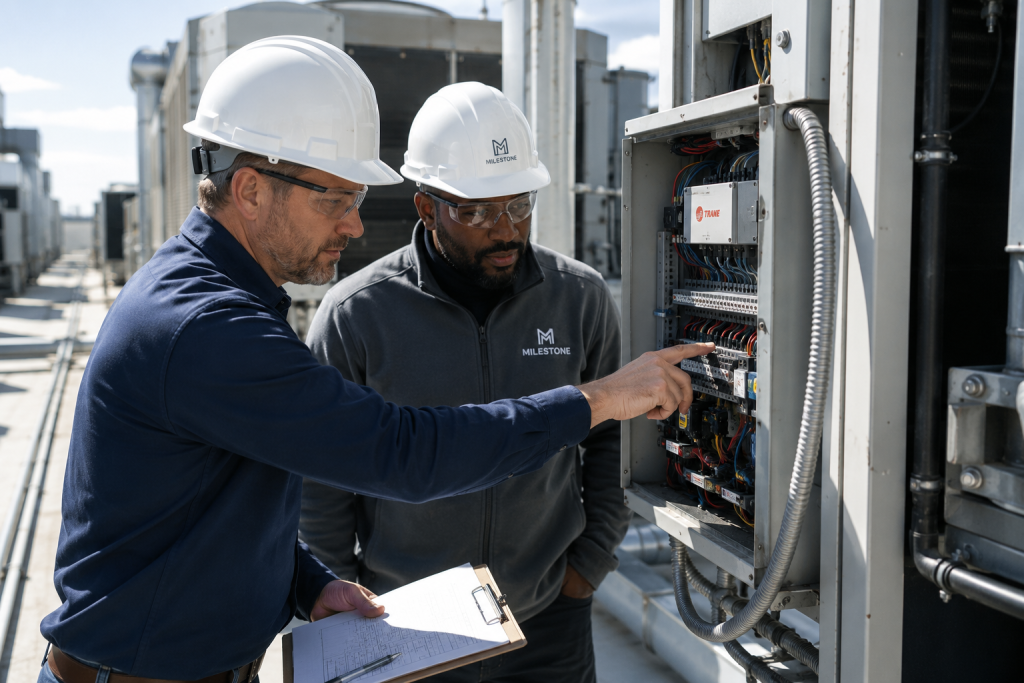
Before any system can be functionally tested, it must be properly installed. Milestone conducts site observations throughout construction to verify that commissioned systems are being installed in accordance with the contract documents and manufacturer requirements.
What this includes:
- Periodic site visits during installation of commissioned systems
- Observation and documentation of equipment installation, piping, ductwork, and controls rough-in
- Identification and logging of installation deficiencies
- Coordination with the contractor for resolution of observed issues
- Verification that installation aligns with approved submittals and design intent

Phase 4: Pre-Functional Readiness Verification
Prior to functional performance testing, each piece of commissioned equipment must demonstrate readiness. Milestone administers pre-functional checklists to confirm that systems are complete, started up, and ready for testing — preventing wasted time and repeated mobilizations.
What this includes:
- Administration and review of contractor-completed pre-functional checklists
- Verification of equipment startup documentation and manufacturer startup reports
- Confirmation of TAB completion and report availability for applicable systems
- BAS point-to-point verification coordination
- Readiness confirmation sign-off before functional testing proceeds

Phase 5: System Testing & Performance Verification
This is the core of the commissioning process — structured, documented functional performance testing that verifies each system operates as designed across required modes and conditions. Milestone executes testing with the installing contractor and BAS provider present, working through each test procedure systematically.
What this includes:
- Execution of functional performance tests for all commissioned systems
- Testing across required operating modes (occupied, unoccupied, seasonal, failure/alarm)
- Verification of sequences of operation against approved control narratives
- Coordination with BAS provider during controls testing and sequence verification
- Documentation of test results, including pass/fail status and observed performance
- Issue identification, logging, and contractor coordination for retesting

Phase 6: Issue Tracking & Coordination
Throughout every phase, Milestone maintains a comprehensive commissioning issues log — a live record of all identified deficiencies, their status, and responsible parties. This is not a punch list. It is a structured tracking tool that keeps the project team accountable and the commissioning process moving forward.
What this includes:
- Maintenance of the commissioning issues log from design through closeout
- Regular distribution to the project team with current status
- Coordination with contractors, designers, and the owner on issue resolution
- Verification of corrective actions and retesting as required
- Escalation to the owner when issues remain unresolved

Phase 7: Final Documentation & Closeout
At project completion, Milestone delivers a final commissioning report that documents the entire commissioning process — from the initial plan through all field activities, test results, and issue resolution. This report serves as a permanent record for the owner and a reference for ongoing operations.
What this includes:
- Final commissioning report including all checklists, test records, and issues log
- Verification that all commissioning issues have been resolved or formally accepted
- Systems manual review and coordination (as applicable)
- Operations and maintenance staff training coordination (as applicable)
- Delivery of all commissioning documentation to the owner

Phase 8: Warranty Phase Support
Commissioning does not end at substantial completion. Building systems often reveal performance issues during the first months of occupancy as seasonal conditions change and the building is put into full use. Milestone provides warranty-phase support to help owners identify and resolve issues while contractor obligations are still in effect.
What this includes:
- Seasonal or deferred functional performance testing (as required)
- Review of owner-reported operational issues and coordination with contractors
- Follow-up site visits to verify system performance under occupied conditions
- Support for warranty claims related to commissioned systems

Our Standards
Aligned with ANSI/NEBB S110
Our commissioning process follows the framework established by the National Environmental Balancing Bureau (NEBB) under ANSI/NEBB S110 – Whole Building Technical Commissioning. This standard defines the requirements for a structured, third-party commissioning process — from the Owner's Project Requirements through final documentation.
Have a Project in Mind?
We work with owners, design teams, and contractors at any phase of a project. Reach out to discuss your commissioning needs.

BAS Coordination
Effective commissioning requires a working understanding of how building automation systems are programmed, tested, and integrated. Milestone has direct experience coordinating with a range of BAS providers — understanding their systems, how their contractors operate, and how to verify sequences of operation in the field.
Contact Us
(123) 456-7890 · elunney@milestone-cx.com